|
General Education Requirements for Baccalaureate Degrees
Ohio University believes that, as an educated person, you need certain intellectual skills in order to participate effectively in society. These include the ability to:
- Build connections between yourself and others through teamwork and intercultural knowledge.
- Reason quantitatively, critically, and ethically.
- Integrate learning between knowledge and experience.
- Communicate effectively in writing and speech.
- Know the materials and methods of inquiry in arts, humanities, social sciences, and natural sciences.
- Synthesize skills and knowledge across the curriculum.
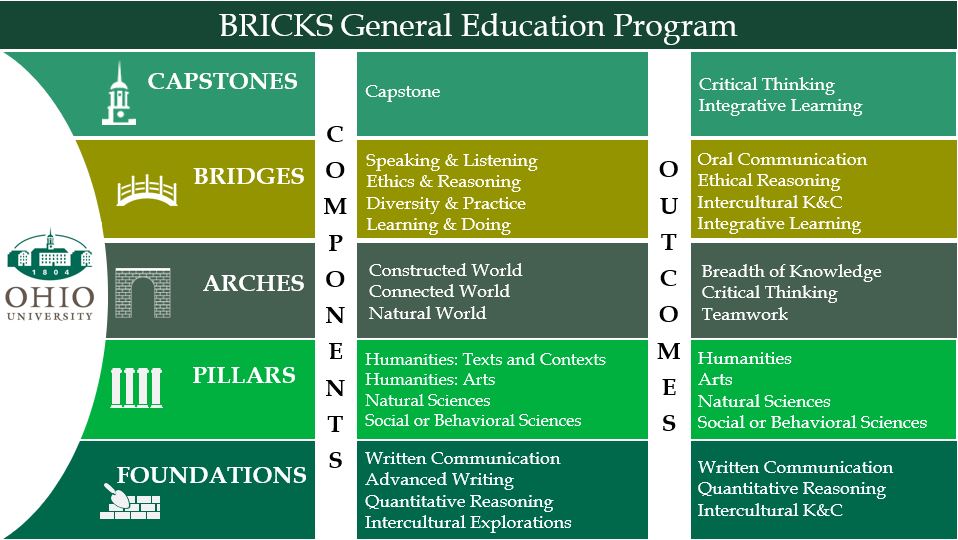
To help you meet these objectives, Ohio University has instituted a five-category general education requirement known as BRICKS. Courses offer learning opportunities to achieve breadth of knowledge and common goals learning outcomes. All baccalaureate degree students (except those in Honors Tutorial College) must complete Ohio University’s BRICKS requirements.
Foundations Requirements
Foundations ground general education. Foundation courses provide you with opportunities to learn to communicate effectively through writing, to reason quantitatively, and to build global and domestic intercultural knowledge and competence.
Written Communication. (FWC) Three credit hours of Written Communication coursework is required. Either ENG 1510 - Writing and Rhetoric I: Foundations (3 hours) or ENG 1610 - Freshman Composition: Writing and Rhetoric (4 hours) (for non-native English speakers only) will satisfy the Written Communication requirement.
Advanced Writing. (FAW) Three credit hours of Advanced Writing coursework is required. Below is a complete list of approved Advanced Writing courses. Courses that meet the Advanced Writing requirement are marked in the catalog with the designation Foundation: Advanced Writing under OHIO BRICKS. It may be possible to fulfill this requirement by taking at least three credit hours in your major; you should see your major advisor for information as to whether your discipline offers such a course or courses.
Quantitative Reasoning. (FQR) You must demonstrate or acquire an acceptable level of quantitative reasoning to satisfy graduation requirements. Three credit hours of Quantitative Reasoning coursework or Placement Level 3 is required. The University uses a combination of your ACT or SAT Math sub-score and your high school GPA to determine an initial math placement or exemption. Students in some majors are required to have a math placement regardless of transfer or advanced placement credit in order to meet the requisite requirements. The choice of the course in which you should enroll, if any, depends on your major, catalog of entry, and math placement, and it should be discussed with your academic advisor.
Students without high school GPA, ACT or SAT scores, advanced placement math credit, or a transferable math course must take a math placement test. To determine if you should take a math placement test and to learn how to do so go to the Math Placement website.
Athens Campus and eCampus students should direct questions to the College of Arts & Sciences at cas.undergrad@ohio.edu or 740.593.2846. Regional campus and eCampus students should contact their student services offices for math placement information.
To enroll in any mathematics (MATH) or other quantitative reasoning course, you must place at the required placement level for that course or satisfy the appropriate requisites. Quantitative reasoning courses are marked in this catalog with the designation Foundation: Quantitative Reasoning under OHIO BRICKS.
DV (Developmental): Placement at this level indicates the need for additional support necessary to complete a quantitative reasoning course. Students with a DV placement are strongly encouraged to talk to their advisors about enrolling in a co-requisite course (MATH 1060L , 1200L , 1500L , PHIL 1200L , or PSY 1110L ) along with the corresponding quantitative course. Alternatively, students may take MATH D004 - Intermediate Algebra with PreAlgebra (5 hours) or MATH D005 - Intermediate Algebra (4 hours) , which are offered through the regional campuses, as a pre-requisite for a quantitative reasoning course.
PL1 (Placement Level 1): Placement at this level indicates preparation for any of the following courses that will fulfill the quantitative reasoning requirement: MATH 1060 - Quantitative Reasoning (3 hours) , MATH 1101 - Elementary Topics in Mathematics I (4 hours) , MATH 1200 - College Algebra (4 hours) , MATH 1250 - Introductory Game Theory (3 hours) , MATH 1321 - Elementary Applied Mathematics I (3 hours) , MATH 1500 - Introductory Statistics (3 hours) , PHIL 1200 - Principles of Reasoning (3 hours) , PSY 1110 - Elementary Statistical Reasoning (3 hours) .
Note: Students who need MATH 1350 - Survey of Calculus (4 hours) should enroll first in MATH 1200 and then take MATH 1350 . Students who need MATH 2301 - Calculus I (4 hours) should begin with MATH 1200 - College Algebra (4 hours) , then take MATH 1300 - Pre-Calculus (4 hours) , and then MATH 2301 . Students cannot earn credit for both MATH 1350 and 2301 .
PL2 (Placement Level 2): Placement at this level indicates preparation for Level 1 courses as well as these additional quantitative reasoning courses: MATH 1300 - Pre-Calculus (4 hours) , MATH 1322 - Elementary Applied Mathematics II (3 hours) , MATH 1350 - Survey of Calculus (4 hours) , MATH 2530 - Introductory Data Science (4 hours) , PSY 2110 - Statistics for the Behavioral Sciences (4 hours) .
Note: MATH 1300 - Pre-Calculus (4 hours) is the requisite course for MATH 2301 - Calculus I (4 hours) . MATH 1300 is not recommended unless you plan on enrolling in MATH 2301 . Students cannot earn credit for both MATH 1350 and 2301 .
PL3 (Placement Level 3): Placement at this level demonstrates quantitative reasoning competence sufficient to fulfill the quantitative reasoning requirement. If your major requires that you enroll in a quantitative reasoning course, placement at Level 3 indicates preparation for MATH 2301 - Calculus I (4 hours) and any course in Level 1 or 2. A Level 3 placement does not guarantee a waiver of college or major requirements in mathematics. Contact your college student services office to see if a college waiver is in effect for your major.
Intercultural Explorations. (FIE) Two credit hours of Intercultural Exploration coursework is required. The following courses fulfill the intercultural explorations requirement and are marked in this catalog with the designation Foundation: Intercultural Explorations under OHIO BRICKS.
Pillars Requirements
Pillars support breadth of knowledge. Pillar courses provide you with opportunities to acquire subject-matter knowledge and learn the methods of inquiry associated with the humanities, natural sciences, and social sciences. Through breadth of knowledge, Pillar courses will enable you to explore multiple viewpoints, ideas, and disciplines important for any career. Note: A course cannot apply toward both pillars and arches.
Humanities: Texts and Contexts. (PHTC) Three credit hours of Humanities: Texts and Contexts coursework is required. The following courses fulfill the Humanities: Texts and Contexts requirement and are marked in this catalog with the designation Pillar: Humanities: Texts and Contexts under OHIO BRICKS.
Humanities: Arts. (PHA) Three credit hours of Humanities: Arts coursework is required. The following courses fulfill the Humanities: Arts requirement and are marked in this catalog with the designation Pillar: Humanities: Arts under OHIO BRICKS.
Natural Sciences. (PNS) Three credit hours of Natural Science coursework is required. The following courses fulfill the Natural Sciences requirement and are marked in this catalog with the designation Pillar: Natural Sciences under OHIO BRICKS.
Social or Behavioral Sciences. (PSBS) Three credit hours of Social or Behavioral Science coursework is required. The following courses fulfill the Social or Behavioral Sciences requirement and are marked in this catalog with the designation Pillar: Social or Behavioral Sciences under OHIO BRICKS.
Arches Requirements
Arches span disciplinary perspectives. Arch courses provide you with opportunities to explore a single topic through multiple liberal arts disciplines. Arch courses also offer opportunities for you to develop your critical thinking and teamwork skills. To complete the requirement, you are required to take at least three credit hours from each of the Connected World, Constructed World, and Natural World courses listed below. Note: A course cannot apply toward both pillars and arches.
Connected World. (ACNW) Three credit hours of Connected World coursework is required. The following courses fulfill the Connected World requirement and are marked in this catalog with the designation Arch: Connected World under OHIO BRICKS.
- ANTH 1010 - Introduction to Cultural Anthropology (3 hours)
- ANTH 2020 - Introduction to World Archaeology (3 hours)
- ANTH 2210 - Animals and Human Society (3 hours) or SOC 2210 - Animals and Human Society (3 hours)
- ANTH 2400 - Breaking the Law (3 hours) or SOC 2400 - Breaking the Law (3 hours)
- ANTH 2450 - Science in Action (3 hours) or SOC 2450 - Science in Action (3 hours)
- ANTH 2700 - Social Justice (3 hours) or SOC 2700 - Social Justice (3 hours)
- ECON 2020 - Gender in the Economy (3 hours)
- ECON 2150 - Frontiers of Economics (3 hours)
- ECON 2300 - Society, Technology and Economic Growth (3 hours)
- ECON 2350 - Sustainability Economics: Energy and Environment in the Modern World (3 hours)
- ECON 2400 - International Trade Relations and Applications (3 hours)
- ECON 2510 - Global and Local Food Economies (3 hours)
- ECON 2600 - Economics of Health Disparities (3 hours)
- ECON 2650 - Fundamental Health Economics (3 hours)
- EDEC 1600 - Introduction to Child Development (3 hours)
- ET 2905 - History of Technology in Society (3 hours) or HIST 2905 - History of Technology in Society (3 hours)
- GEOG 1310 - Globalization and the Developing World (3 hours) POLS 2000Z - American Politics, Policy, and Administration: American Civic Literacy (3 hours)
- GEOG 2400 - Environmental Geography (3 hours)
- GEOG 2500 - Introduction to City Planning (3 hours)
- GH 2190 - Introduction to Immigrant & Migrant Health (3 hours)
- HIST 2460 - The Rise of Modern Asia (3 hours)
- HIST 2750 - Disease, Medicine, and Society in Europe to 1800 (3 hours)
- HLTH 2000 - Introduction to Public Health (3 hours)
- INST 2200 - Introduction to African Studies (3 hours)
- INST 2400 - Introduction to European Studies (3 hours)
- INST 2600 - Introduction to Latin American Studies (3 hours)
- LING 2750 - Introduction to Language and Culture (3 hours)
- LING 2800 - Language in America (3 hours)
- LING 2850 - Sustaining the Mother Tongue: An Introduction to Language Endangerment and Language Revitalization (3 hours)
- ML 2701 - Introduction to Latinx Studies (3 hours)
- POLS 1500 - Introduction to Global Politics (3 hours)
- POLS 2000 - American Politics, Policy, and Administration: American Civic Literacy (3 hours)
- POLS 2000Z - American Politics, Policy, and Administration: American Civic Literacy (3 hours)
- POLS 2200 - The Politics of Law (3 hours)
- POLS 2300 - Democracies and Dictatorships Around the World (3 hours)
- POLS 2700 - Introduction to Political Theory (3 hours)
- PSY 2210 - Physiological Psychology (3 hours)
- PSY 2310 - Cognitive Psychology (3 hours)
- PSY 2410 - Child and Adolescent Psychology (3 hours)
- PSY 2420 - Educational Psychology (3 hours)
- PSY 2510 - Social Psychology (3 hours)
- PSY 2540 - Psychology of Peace and Cooperation (3 hours)
- PSY 2710 - Psychopathology (3 hours)
- PSY 2720 - Psychology of Personality (3 hours)
- SOC 2000 - Contemporary Social Problems (3 hours)
- SOC 2050 - Sociology through Film (3 hours)
- SOC 2100 - Introduction to Social Psychology (3 hours)
- SOC 2200 - Introduction to the Family (3 hours)
- SOC 2300 - Social Inequalities and Social Change (3 hours)
- SOC 2310 - Sociology of Health and Health Care (3 hours)
- SOC 2380 - Global Social Change (3 hours)
- SOC 2600 - Criminal Justice (3 hours)
- SOC 2610 - Deviant Behavior (3 hours)
- SOC 2700 - Social Justice (3 hours)
- SOC 2800 - Gender, Crime, and Law (3 hours)
- WGSS 2300 - Women, Gender, and Sexuality in a Global Context (3 hours)
Constructed World. (ACSW) Three credit hours of Constructed World coursework is required. The following courses fulfill the Constructed World requirement and are marked in this catalog with the designation Arch: Constructed World under OHIO BRICKS. Quantitative courses in the Constructed World (indicated with an asterisk) can, if necessary, be used to satisfy the Foundations: Quantitative Reasoning requirement instead. In such cases, another Constructed World course must be used to fulfill this Arch requirement.
Natural World. (ANW) Three credit hours of Natural World coursework is required. The following courses fulfill the Natural World requirement and are marked in this catalog with the designation Arch: Natural World under OHIO BRICKS.
Arch Themes
You are encouraged (but not required) to take courses from a single Arch theme in order to build your critical thinking and teamwork skills through multiple liberal arts disciplines focused on the same broad topic. Descriptions of the Arch themes are provided below:
The Global Connections Theme explores diverse cultural, economic, social, political, biological, and ecological systems in historical and contemporary contexts, with an emphasis on interconnections that shape our local and global communities. Courses examine the form and movement of people, ideas, resources, technologies, and processes within and across borders. Learn how to communicate across cultures, work in diverse global contexts, and become a successful global citizen in a rapidly changing multicultural world. The following courses fall under the Global Connections Theme:
The Health and Wellness Theme explores interconnections between minds, bodies, and society that affect our personal and community health and well-being. These interconnections include local, regional, national, and global systems of nourishment, caregiving, healing, support, recovery, and health care, both past and present. Courses in this Theme also examine contributors to illness, disease, injury, and death as well as ways in which social, economic, environmental, and political inequities adversely affect health and wellness. Learn how to optimize quality of life through healthy nutrition, exercise, and other lifestyle choices and how personal well-being is connected to the public policies, social norms, and general welfare of our communities. The following courses fall under the Health and Wellness Theme:
The Science and Technology Theme explores the grand landscape of science, technology, and society, and the interplay among them. Learn how to synthesize the insights from different disciplines and critically evaluate the reciprocal influence of these areas on one another. The following courses fall under the Science and Technology Theme:
The Society and Justice Theme examines the interdependency of social norms and law, and how this relationship in turn shapes conceptions of justice. In this Theme, students will learn how individuals and groups use socio-political, scientific, and legal tools to mobilize for justice and the kinds of barriers they encounter along the way. Learn how your voice and actions can play a role in positive social change. The following courses fall under the Society and Justice Theme:
The Sustainability Theme allows students to explore a range of topics related to sustainability, such as environmental science, conservation, and sustainable development. The Sustainability Theme places emphasis on critical thinking and teamwork directed at sustainability issues, problems, and solutions. Achieving sustainability will require an understanding of human and environmental systems and the complex interactions between them, from local to global levels. This theme invites you to envision a meaningful future, to explore your own personal values, and to think critically about economic, social, political, cultural, and scientific assumptions about humans’ relationships to the environment. The following courses fall under the Sustainability Theme:
Bridges Requirements
Bridges connect common goals to disciplines. Bridge courses provide you with opportunities to develop specific abilities frequently sought by employers and important to an educated society.
Speaking & Listening. (BSL) One credit hour of Speaking & Listening coursework is required. This catalog contains a complete list of Speaking and Listening courses marked with the designation Bridge: Speaking and Listening under OHIO BRICKS. To view the courses marked as Speaking & Listening, visit the Bridges: Speaking & Listening page.
Ethics & Reasoning. (BER) One credit hour of Ethics & Reasoning coursework is required. This catalog contains a complete list of Ethics and Reasoning courses marked with the designation Bridge: Ethics and Reasoning under OHIO BRICKS. To view the courses marked as Ethics & Reasoning, visit the Bridges: Ethics & Reasoning page.
Diversity & Practice. (BDP) One credit hour of Diversity & Practice coursework is required. This catalog contains a complete list of Diversity and Practice courses marked with the designation Bridge: Diversity and Practice under OHIO BRICKS. To view the courses marked as Diversity & Practice, visit the Bridges: Diversity & Practice page.
Learning & Doing. (BLD) One credit hour of Learning & Doing coursework is required. This catalog contains a complete list of Learning and Doing courses marked with the designation Bridge: Learning and Doing under OHIO BRICKS. To view the courses marked as Learning & Doing, visit the Bridges: Learning & Doing page.
Capstones Requirement
Capstones (CAP) complete general education. Capstone courses provide you with opportunities to integrate and apply what you have learned throughout your learning journey.
Two credit hours of Capstone coursework is required. This catalog contains a complete list of Capstone courses marked with the designation Capstone under OHIO BRICKS. To identify Capstone courses, place “Capstone” in the keyword or phrase search from the Course Descriptions page. It may be possible to fulfill this requirement by taking at least two credit hours in your major; you should see your major advisor for information as to whether your discipline offers such a course or courses.
Note: The UCC General Education Committee approved allowing any Arch: Natural World (ANW) or any Pillar: Natural Science courses to meet either the PNS or ANW general education requirements for the full AY 2025-2026.
General Education Requirements for Applied Associate Degrees
Students completing Ohio University’s applied associate degrees are required to complete 15 credit hours of Ohio Transfer 36-approved coursework including:
To complete the minimum 15 credit hours of Ohio Transfer 36-approved coursework, students may also complete OHIO’s Ohio Transfer 36-approved Second Writing course, ENG 2800 - Writing & Rhetoric II (3 hours) or OHIO’s Ohio Transfer 36-approved Oral Communication course, COMS 1030 - Fundamentals of Public Speaking (3 hours) .
General Education Requirements for Associate of Arts and Associate of Science Degrees
Students completing Ohio University’s Associate of Arts and Associate of Science degrees are required to complete 36 hours of Ohio Transfer 36-approved coursework with a minimum of 24 semester hours from the following:
- Written Communication (FWC) (3 hours). Either ENG 1510 - Writing and Rhetoric I: Foundations (3 hours) or ENG 1610 - Freshman Composition: Writing and Rhetoric (4 hours) (for non-native English speakers only) will satisfy the written communication requirement.
- Quantitative Reasoning (FQR) (3 hours). Courses that fulfill Quantitative Reasoning requirement are listed above.
- Humanities: Arts (PHA) (3 hours). Courses that fulfill the Humanities: Arts requirement are listed above.
- Humanities: Texts and Contexts (PHTC) (3 hours). Courses that fulfill the Humanities: Texts and Contexts requirement are listed above.
- Social or Behavioral Sciences (PSBS) or Connected World (ACNW) (6 hours). Courses that fulfill the Social or Behavioral Sciences requirement are listed above. Courses that fulfill the Connected World requirement are listed above.
- Natural Sciences (PNS) or Natural World (ANW) (6 hours). Courses that fulfill the Natural Sciences requirement are listed above. Courses that fulfill the Natural World requirement are listed above.
To complete the minimum 36 credit hours of Ohio Transfer 36-approved coursework, students may also complete OHIO’s Ohio Transfer 36-approved Second Writing course, ENG 2800 - Writing & Rhetoric II (3 hours) and/or OHIO’s Ohio Transfer 36-approved Oral Communication course, COMS 1030 - Fundamentals of Public Speaking (3 hours) .
Completing BRICKS with an External Degree
Students who complete the minimum requirements of the Ohio Transfer 36, Associate of Arts (AA), Associate of Science (AS), or a bachelor degree from an institution of higher education accredited by regional accrediting commissions that have been recognized by the Council on Higher Education Accreditation (CHEA) prior to enrollment in a degree-seeking program at Ohio University will receive transfer credit equivalent to fulfilling Ohio University’s BRICKS general education requirements in Foundations (excluding the Advanced Writing component, which requires transfer credit for a suitable course) Pillars, and Arches. For more information about Ohio Transfer 36, see Transfer Credit .
|
